iKuai Soft Router 3.6.0 Released: Now Supports CPU Frequency Scaling
Recently, the iKuai soft router system version 3.6.0 was released, now supporting the CPU frequency scaling mode that many users have been waiting for. If you use iKuai, it is recommended to update.

In simple terms, CPU frequency scaling adjusts the CPU's operating frequency. Running at a lower frequency reduces power consumption, while running at a higher frequency improves efficiency. Previously, iKuai seemed to only operate at the base frequency. For example, in xiaoz's soft router (Beelink GK55) equipped with a J4125 CPU, the base frequency is only 2.00 GHz. With frequency scaling support, it can theoretically reach the J4125 CPU's maximum frequency of 2.70 GHz, fully unleashing its performance (which is particularly important when handling multiple connected devices or running virtual machines).
iKuai OS 3.6.0 Update Highlights
This update includes many changes and can be considered a significant release.
New Features:
- System Settings -- Advanced Settings -- CPU Interrupt Control: CPU Frequency Scaling Mode
- Advanced Applications -- Samba Service
- System Settings -- RAID Management
- System Settings -- Advanced Settings -- Kernel Settings (e.g., enabling BBR and connection session timeouts)
- Network Settings -- VPN Client -- SD-WAN (allows users to experience SD-WAN intelligent networking)
Bug Fixes:
- Fixed a bug where the Docker plugin might fail to start services on boot.
Optimizations:
- Kernel version upgraded to 5.10.99
- Support for Intel 11th Gen and AMD Ryzen processors
- Updated numerous network card drivers
- Integrated the latest Hyper-V drivers
- Deep optimization of system forwarding performance
- Deep optimization of PPPOE forwarding performance
- Recommendation: For devices that are not too old, it is recommended to use the 64-bit system (2GB RAM or more) for better performance.
Enabling CPU Frequency Scaling Mode
After updating to version 3.6.0, go to System Settings -- Advanced Settings -- CPU Interrupt Control to adjust the CPU Frequency Scaling Mode. The default setting is "ondemand - Fast Adjustment Mode."
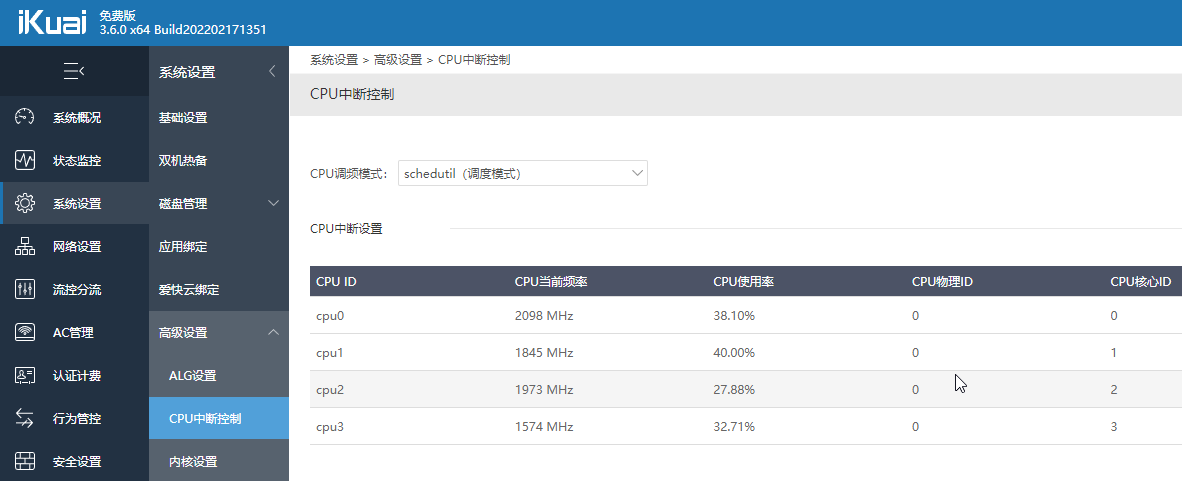
The meanings of the different modes are as follows:
- performance (Performance Mode): The system operates at the set maximum frequency at full load, keeping the frequency at the maximum value within the set range.
- conservative (Smooth Adjustment Mode): In this mode, the system uses lower frequency drop response parameters. The frequency drops faster when idle, saving more energy, but CPU speed adjustments are relatively slower.
- powersave (Power Saving Mode): The system operates at the set minimum frequency under low load.
- ondemand (Fast Adjustment Mode): This is generally the system default mode, automatically adjusting the CPU frequency based on needs. Its characteristic is that frequency increase requires a trigger condition, with a rapid response, while frequency decrease does not require a trigger and gradually drops when high frequency is not needed.
- schedutil (Scheduler Mode): Offers faster response speed and more precise frequency scaling, resulting in better energy efficiency.
Personal Recommendation
Unless there are special circumstances, the default "ondemand" mode is usually sufficient. If you run virtual machines for extended periods and pursue better performance, you can try the performance mode. With iKuai's support for "CPU Frequency Scaling," the soft router's CPU performance can be utilized more reasonably. It is recommended to update in time.
For detailed information about iKuai CPU Interrupt Control, please refer to the official documentation: CPU Interrupt Control