How to Install and Configure Stat Hub for Self-Hosted Server Monitoring on Linux
Stat Hub is a service that helps collect and display the status of multiple servers. It consists of two parts: a server component for receiving, storing, and displaying status data, and a client component for collecting and sending status to the server. Stat Hub does not have as powerful features as Zabbix, making its deployment much simpler.

Installation Method
You can install it with a single command. Simply copy and run the following command:
# Download and install using curl
curl --insecure https://raw.githubusercontent.com/likexian/stathub-go/master/setup.sh | sh
# If curl is unavailable, use wget
wget --no-check-certificate -O - https://raw.githubusercontent.com/likexian/stathub-go/master/setup.sh | sh
# Open the required port (iptables)
iptables -I INPUT -p tcp --dport 15944 -j ACCEPT
service iptables save
service iptables restart
That's it! The installation is complete. Next, access https://ip:15944 in your browser (note the HTTPS address; if the browser warns of a security risk, choose to allow access). The default password is likexian. You can change it after logging in. The interface looks like this:
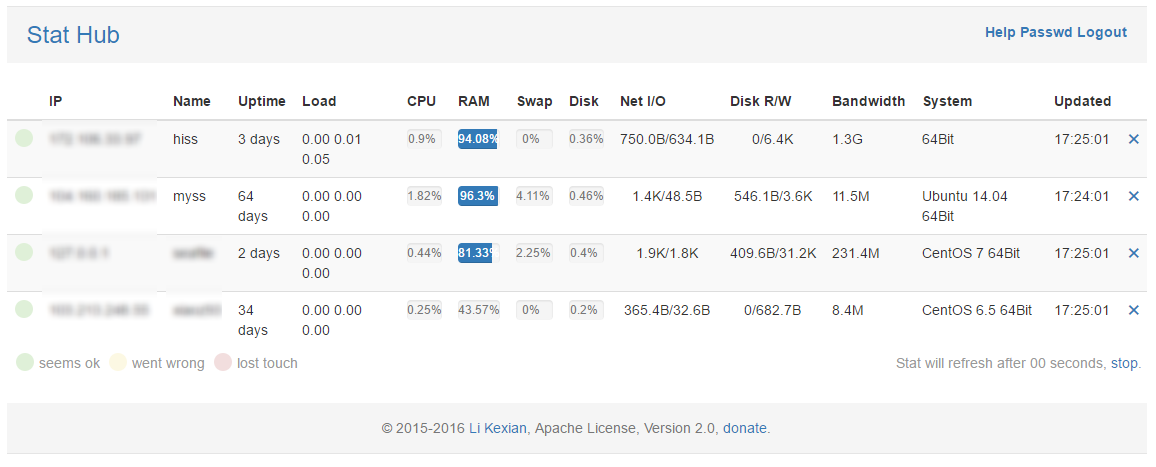 Stat Hub Interface (Click to enlarge)
Adding Multiple Clients
Click the Help button in Stat Hub and follow the instructions, or visit https://ip:15944 to add clients according to the prompts. This allows you to monitor multiple servers. Stat Hub uses crontab to collect data every minute. If no data is displayed, run crontab -l to check if the scheduled task was added successfully.
Access via Domain Name (Nginx Reverse Proxy)
Add the following rules to your Nginx vhost configuration file and reload Nginx for the changes to take effect:
server
        {
        listen          80;
        server_name     jk.bk.tn; # Replace with your domain
        location / {
           proxy_pass https://127.0.0.1:15944;
           proxy_redirect off;
           proxy_set_header X-Real-IP $remote_addr;
           proxy_set_header X-Forwarded-For $proxy_add_x_forwarded_for;
    }
}
Summary
Stat Hub does not have real-time alerting features; if a server goes down, you can only check the panel manually. It is hoped that the author will add real-time notification features in the future, such as email alerts. Additionally, the RAM monitoring includes the Cache part, which may make the RAM usage appear less accurate, though the impact is minimal. While Stat Hub is not powerful, it is indeed very simple.
Project Address: Stat Hub