My Experience with an ICBC Card Freeze and Unfreeze Process
Recently, a netizen told me that ICBC's cross-border remittance fees are relatively low (40 yuan per transaction, no telegraph fee). Therefore, I decided to use my ICBC debit card, which has been idle for many years. First, I downloaded the ICBC mobile app, but it prompted me to complete identity verification. Considering I haven't made any transactions with this card for over 4 years, this verification requirement was reasonable. So, I re-uploaded my ID card photo (my ID card had expired and been replaced) and completed facial recognition. The whole process went smoothly.

The Problem
First, I successfully withdrew 1,000 yuan from Alipay to my ICBC account. However, when I tried to purchase foreign exchange, I received error code 9920 with the following message:
Your account service has been suspended due to abnormal transactions. Please visit a branch to re-verify your identity.
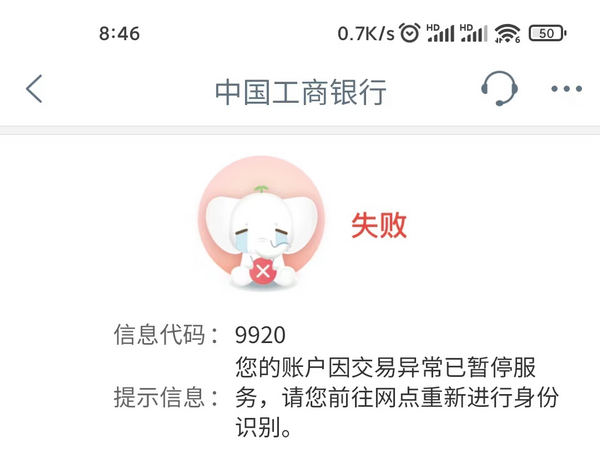
I continued to try transferring money and recharging Alipay, but all attempts failed. It was clear that my bank card had been frozen. The symptoms were: funds could be deposited, but withdrawals and non-counter operations were blocked.
Unfreezing at the Branch
The next day, I went to a nearby ICBC branch. The lobby manager asked me to fill out two forms:
- ICBC Personal Settlement Account Opening and Use Risk Warning Letter
- Account Verification Investigation Form
After waiting for over an hour, it was finally my turn. The teller seemed impatient and asked me two questions:
- Have you not used the card for a long time? I answered: Yes.
- Since the card hasn't been used for a long time, what is the purpose of reactivating it now? I answered: To save money.
The teller did not process my request directly but asked me to find the lobby manager to help unfreeze the card via the self-service machine. I went back to the lobby manager, but the self-service machine unfreezing failed. The lobby manager then directed me to the counter customer service. I returned to the counter window and informed them that the self-service machine could not unfreeze the card. The teller re-verified my identity, accepted my ID card and bank card, and completed the unfreezing procedure within a few minutes. This time, they did not ask me any further questions and simply confirmed that the process was done.
I did not leave immediately. I continued to use the app to purchase foreign exchange and transfer money. This time, everything went smoothly. I was relieved that my account was not downgraded to a Class II account.
Summary: How to Avoid Such Issues
Based on this experience, I have a few thoughts and suggestions:
- Use the card regularly: To avoid your bank card being frozen due to long-term inactivity, it is best to conduct small transactions periodically to maintain account activity. For example, bind it with UnionPay or Alipay and make regular purchases.
- Update information promptly: If there are any changes to your identity information (such as renewing your ID card), update them in the bank system immediately to avoid unnecessary trouble.
- Do not transfer urgent funds to inactive cards: Because they may be subject to risk control measures.
The above is for reference only; everyone's situation may differ. If you encounter problems, it is recommended to call the bank's customer service hotline or visit a branch for consultation. Have you ever experienced a frozen bank card? Feel free to share your story in the comments.