TCPLab Adds PHP Version Detection to Check for CVE-2026-109618/109619 Vulnerabilities
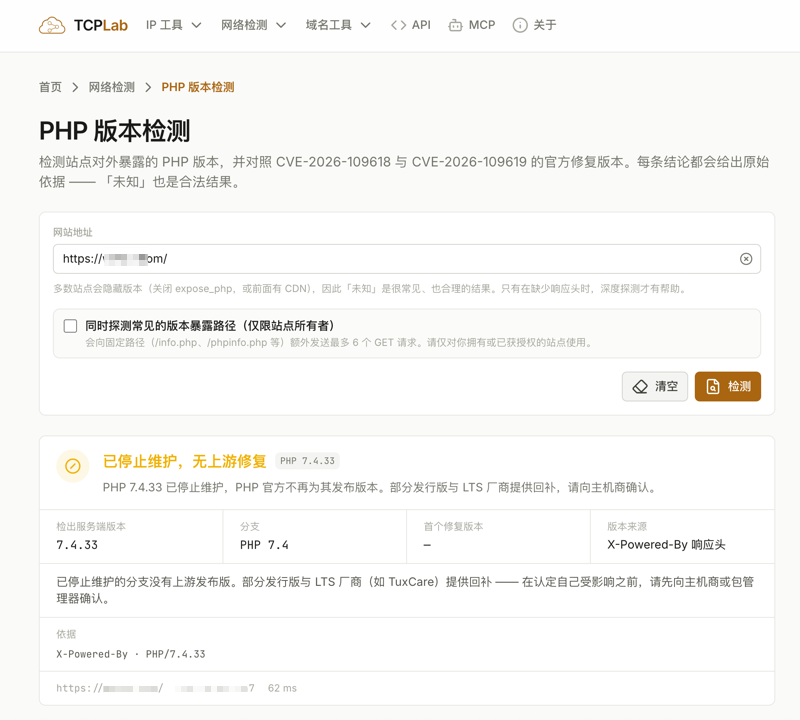
Recently, two P0-level vulnerabilities have been discovered in PHP: CVE-2026-109618 and CVE-2026-109619, affecting most websites globally. To facilitate self-checks for users, TCPLab Network Toolbox has added a PHP version detection feature to assist in checking whether the PHP version used by a website is affected by these vulnerabilities. If an impact is confirmed, it is recommended to upgrade the PHP version to the patched version recommended by the official PHP team as soon as possible.

PHP Version Detection Address: https://tcp.lc/zh/php-version-check
Feature Description
- Detects the PHP version information used by a website online via a web page, requiring no additional software installation.
- Suitable for scenarios such as website development, server maintenance, and PHP environment troubleshooting.
- Helps developers understand the potential PHP runtime environment of target websites.
- Can be used to assist in checking if the PHP version is affected by CVE-2026-109618/CVE-2026-109619 vulnerabilities.
- Detection results are for reference only; actual detection capabilities may be influenced by website architecture, security policies, and server configurations.
Detection Principle
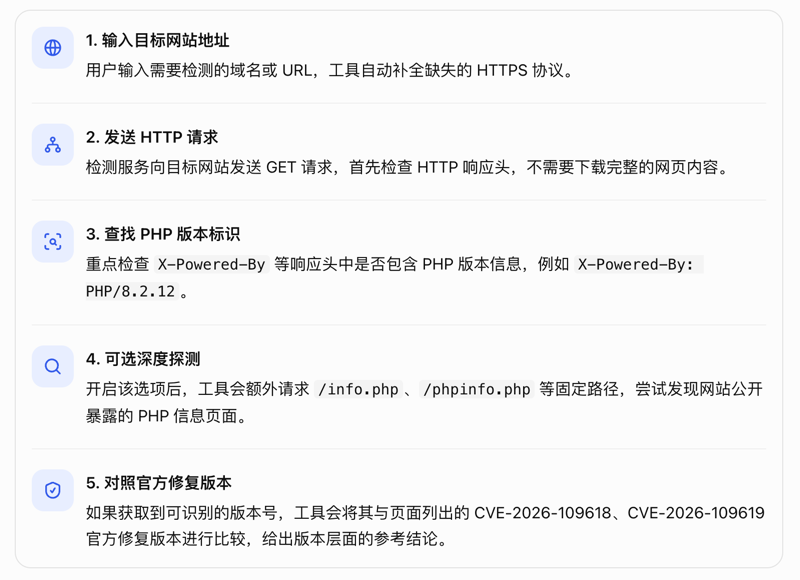
The TCPLab PHP version detection tool identifies the PHP version used by a website primarily through the following methods:
- HTTP Response Header Detection: Sends HTTP requests to the target website to check if PHP version information is publicly disclosed in response headers like
X-Powered-By. - Deep Probing: When enabled by the user, attempts to access common paths such as
/info.phpor/phpinfo.phpto find publicly available PHP information pages. - Version Comparison: Compares the obtained version number with specified official security patch versions to provide security references.
- Non-intrusive Detection: Only retrieves public information via HTTP requests; does not attempt penetration testing, vulnerability exploitation, or injection tests.
Note: Detection results depend on publicly available information from the website. Some websites hide their PHP version or filter related information via CDNs or reverse proxies, so it cannot guarantee detection of all websites. Furthermore, the existence of security vulnerabilities cannot be determined solely based on the version number. This tool serves only as an auxiliary reference and cannot be used as an accurate judgment basis. Users must bear relevant risks and responsibilities!
Partial Screenshots
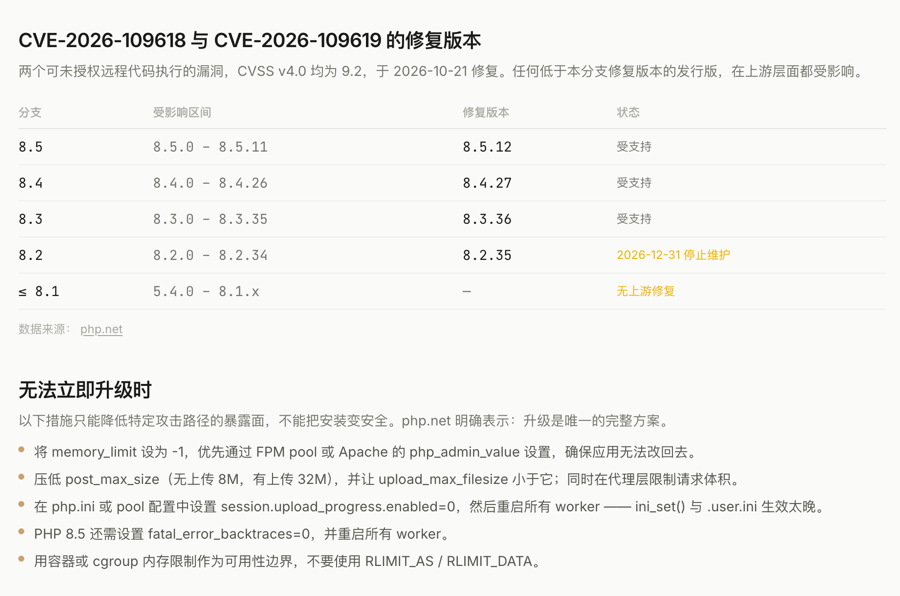
Conclusion
If your website uses PHP, take a few minutes to detect it and see if the current version poses any potential risks. If you find that the version might be affected, it is recommended to verify and upgrade as soon as possible. Please note that detection results are for reference only and cannot completely replace server-side checks.
We hope this small tool helps everyone avoid unnecessary detours and makes running websites more secure. TCPLab will continue to improve its network tools to provide developers with more convenient detection and troubleshooting tools. We also welcome your feedback and comments.
TCPLab Official Website: https://tcp.lc/zh/